The following is a fictional story based on real patterns we observe across biotech fundraising.
Dr. Priya Anand had done everything right.
Three years of platform development at Veridian Therapeutics. A lead asset with Phase I safety data that made her scientific advisory board describe it as "the cleanest early signal we've seen in this indication in a decade." A co-founder with an exit. A cap table that included two names any biotech investor would recognize.
She had also done something most founders don't. She had spent the six months before her Series A round working on her narrative. She knew her elevator pitch. She knew her competitive landscape cold. She had practiced the "why now" answer until it came out like breathing.
The first meeting with Arclight Ventures had gone better than she expected. Marcus, the partner who led their oncology practice, had leaned forward twice. That almost never happens in a first meeting.
He asked for a second meeting. She took that as a signal.
She was right that it was a signal. She was wrong about what it meant.
The night before the second meeting
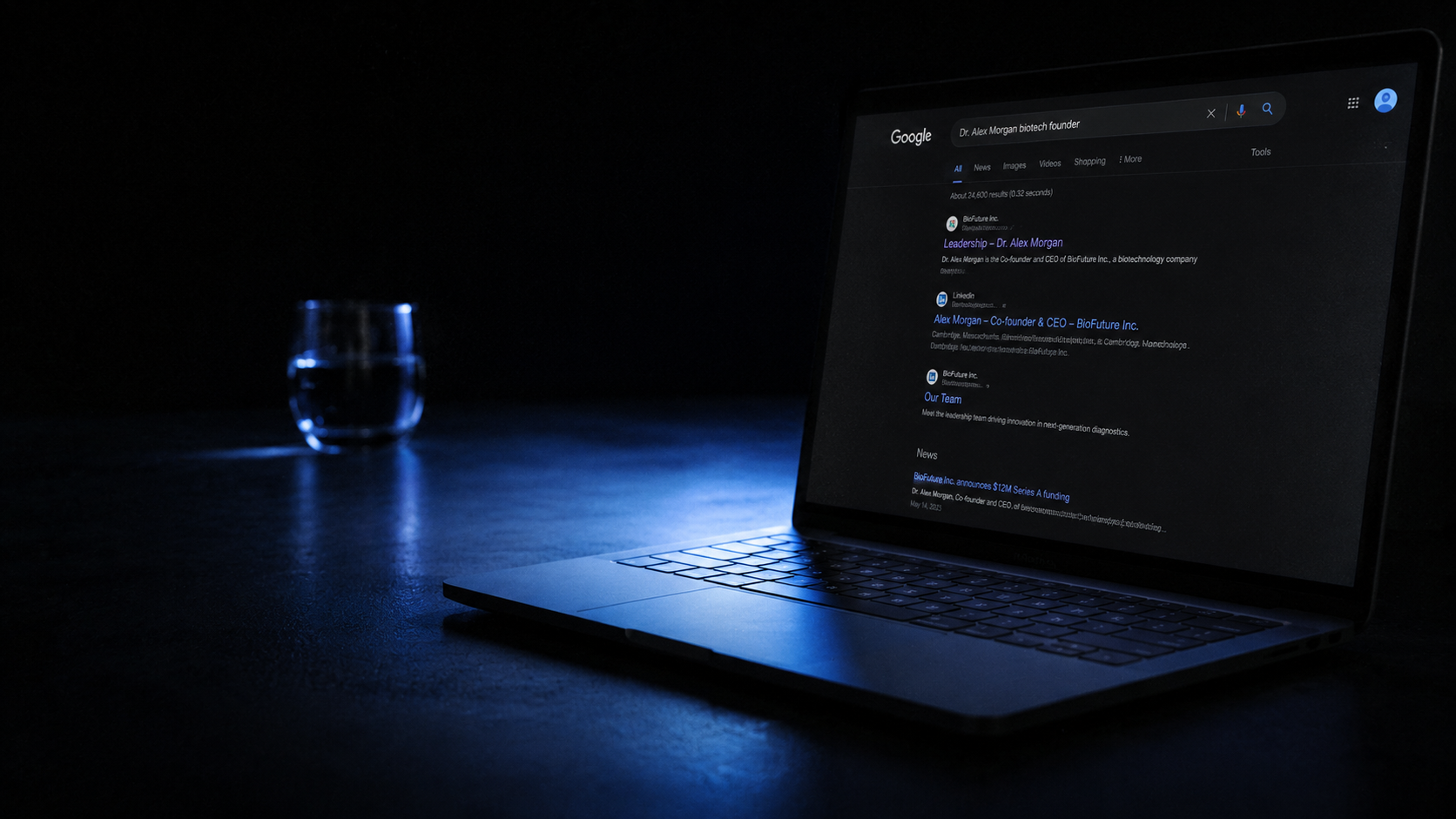
Marcus got home at 9:47pm. His daughter was already asleep. He poured a glass of water, opened his laptop, and did what he always does before a second meeting.
He Googled the founder.
Not the company. The founder.
He typed "Priya Anand biotech" into the search bar.
The first result was a LinkedIn profile with 312 connections and a last post from eight months ago congratulating someone on a funding announcement. The second result was a conference agenda from 2023 where she was listed as a panelist. The third was a university press release about her PhD from six years earlier.
He clicked through to her LinkedIn. The about section described her as "a passionate scientist with a decade of experience in oncology drug development." There was nothing about Veridian. Nothing about the Series A. Nothing about what she was building or why it mattered or what made her the person to build it.
He searched Veridian Therapeutics. The website loaded slowly. The homepage said "Pioneering the next generation of targeted oncology therapeutics." There was no blog, no publications section beyond a single paper from 2022, no case studies, no team page with faces and names.
He typed "Veridian Therapeutics" into ChatGPT out of habit.
ChatGPT said it had no reliable information about the company and suggested he search Google for more recent details.
Marcus closed his laptop at 10:23pm. He had a 7am call with a portfolio company and needed to sleep.
But something had shifted. Not dramatically. Not consciously. Just a small recalibration that happens when your expectations meet a gap and your brain quietly files it away for later.
The second meeting
Priya crushed the second meeting. She answered the mechanism of action questions without notes. She navigated the competitive landscape question with the confidence of someone who had spent three years studying every program in the space. When Marcus's colleague pushed back on the patient selection strategy she had a data slide ready before he finished the sentence.
Marcus was engaged. He asked good questions. He stayed fifteen minutes past the scheduled end of the meeting.
But there was a moment, about forty minutes in, when he asked a question she hadn't prepared for.
"I was trying to find more about your background online before today. I couldn't find much. Is that intentional?"
Priya laughed it off. "I've been heads down in the lab. I'm not a big social media person."
Marcus nodded and moved on.
Priya didn't think about that exchange again for three months.
What happened next
Arclight passed six weeks later. The email from Marcus was warm and specific. He cited portfolio overlap as the primary reason. He wished her well and said he would follow Veridian's progress.
Priya spent two weeks trying to figure out what portfolio overlap he was referring to. She couldn't find it. Arclight's existing investments didn't directly compete with her program at any level that should have mattered.
She raised her Series A eleven months later. Different lead. Slightly worse terms than the conversations she'd been having earlier in the process. The round took longer than anyone had modeled.
She never knew what happened with Arclight.
What actually happened with Arclight
Marcus passed because of portfolio overlap. That part was true.
But the overlap he was referring to wasn't a scientific conflict. It was a confidence conflict.
In his IC memo, under the section titled "Founder Assessment," he had written three sentences that he would later not remember writing.
"Strong in the room. Limited external validation footprint. Harder to build conviction on the person versus the science."
That phrase, "limited external validation footprint," was the translation of what he had found when he Googled her at 9:47pm.
It wasn't that she was unimpressive. She was deeply impressive. It was that the digital world had no record of it. And in a market where Marcus sees 400 decks a year and has to write conviction memos that his partners can stress-test, the absence of a record creates a question that is almost impossible to answer from inside a meeting room.
The question is not "is this founder credible?" The question is "can I defend my conviction to my partners when there is nothing external to point to?"
Most investors will never say this to a founder. It feels unfair to say it. It might even be unfair. But it is how the decision gets made.
The thing no pitch deck fixes
Priya's pitch deck was excellent. Her data was real. Her narrative was sharp. Her responses to hard questions were better than most of the Series A founders Marcus had backed.
None of that addressed the 10:23pm problem.
Because the 10:23pm problem is not a pitch problem. It is a presence problem. It is the gap between who you are in the room and what the world knows about you outside of it.
Investors make decisions across two time frames simultaneously. There is the meeting, where you control almost everything. And there is the research that happens before and after the meeting, where you control almost nothing unless you have built something to control it with.
A strong LinkedIn presence is not vanity. It is the document that answers the question Marcus was asking at 10:23pm. It is the record that makes conviction defensible. It is the evidence that you exist as a credible voice in your field before anyone ever agreed to take your meeting.
A blog post about your mechanism of action is not content marketing. It is a signal to an AI model that your company exists, operates in a specific category, and has something worth indexing.
A consistent posting cadence is not social media strategy. It is the compound interest on your credibility that starts paying out at exactly the moment when someone searches your name the night before a meeting.
What Priya did differently for her next raise
After her Series A closed, Priya sat down with her co-founder and made a decision. They would spend four hours a month on their digital presence. Not more. Four hours. But they would do it consistently and they would do it with intention.
She updated her LinkedIn about section to describe exactly what Veridian was building, who it was for, and why the timing was right. She started posting once a week. Not motivational content. Not conference announcements. Specific, opinionated, scientifically grounded perspectives on the oncology landscape that only someone who had spent three years building in the space could write.
Her co-founder did the same. Different voice. Different angle. The same company, seen from two different vantage points that together painted a complete picture.
They hired someone to write two blog posts a month about their technology, their patient population, and the scientific questions they were working to answer.
Eighteen months later, when they started conversations for their Series B, the first thing three separate investors mentioned in their opening emails was something they had read. One mentioned a LinkedIn post. One mentioned a blog. One mentioned that when she searched Veridian on Perplexity she got a detailed, accurate, confidence-building summary back.
The Series B took four months. The lead investor later told her it was one of the fastest conviction processes his firm had run in two years.
He didn't mention the Perplexity search in that conversation. But it was in his notes from the day he first looked them up.
The 10:23pm audit
Here is a question worth sitting with tonight.
If an investor Googled you at 10:23pm before your next meeting, what would they find?
Not what you hope they would find. What they would actually find, right now, if they opened a browser and typed your name.
If the answer is "not much," that is not a reflection of your science or your credentials or your potential. It is a reflection of a gap that is entirely fixable.
The fix is not complicated. It does not require becoming a content creator or spending hours on social media every week. It requires building a consistent, credible, scientifically grounded digital presence that does the work of establishing your authority while you are in the lab, in the clinic, in the meeting room, or asleep.
That is what we do at Bioverse.
If you want to know what an investor finds when they search you tonight, we will show you. Free. No pitch.